Robinhood Chain: Best Trading Bots in 2026

Robinhood Chain went live on July 1, 2026, and in less than two weeks it has become one of the busiest new networks in crypto. Built as an Ethereum layer-2 using Arbitrum’s Orbit technology, Robinhood Chain was designed to bring tokenized real-world assets — starting with Stock Tokens tied to names like NVIDIA, Apple, and Google — onchain, trading 24/7 and plugging directly into DeFi as loan collateral. ROBINHOOD. The chain launched with a stacked partner list from day one: Uniswap runs a dedicated AMM as core public liquidity, Chainlink powers its oracle and cross-chain infrastructure, and BitGo and Alchemy provide institutional-grade custody and backend support. Robinhood Earn, the network’s flagship lending product, already offers roughly 7% APY on the USDG stablecoin through the Morpho protocol. In its first two weeks, the chain pulled in close to 800,000 active addresses, processed 3.6 million transactions in a single day, and cleared over $800 million in decentralized exchange volume in 24 hours — numbers that rival chains many years its senior.

What makes this moment interesting is who actually showed up. Robinhood built the chain to be a regulated onramp for tokenized real-world assets, but so far tokenized stocks account for barely $13 million of activity on the network, while memecoins and stablecoins dominate both transaction count and market value. Robinhood itself, the zero-commission brokerage app that popularized fractional stock and options trading for a generation of retail investors, now serves close to 28 million customers across 38 countries. With Robinhood Chain, the company is betting that its enormous existing user base — plus a wave of crypto-native degens chasing the newest liquidity — will turn a brokerage app into full-blown onchain financial infrastructure. For traders, that means a brand-new, fast, cheap chain with real volume and, crucially, no dominant “default” trading terminal yet. Whoever moves early captures the best fills, the lowest competition, and the widest selection of untouched tokens. That’s exactly where dedicated multi-chain trading terminals come in — tools built specifically to help you buy, snipe, and manage positions on new chains faster than doing it manually through a DEX interface. Below are four of the best Robinhood Trading Terminals: BasedBot, Maestro, Sigma Bot, and Fomo.
BasedBot
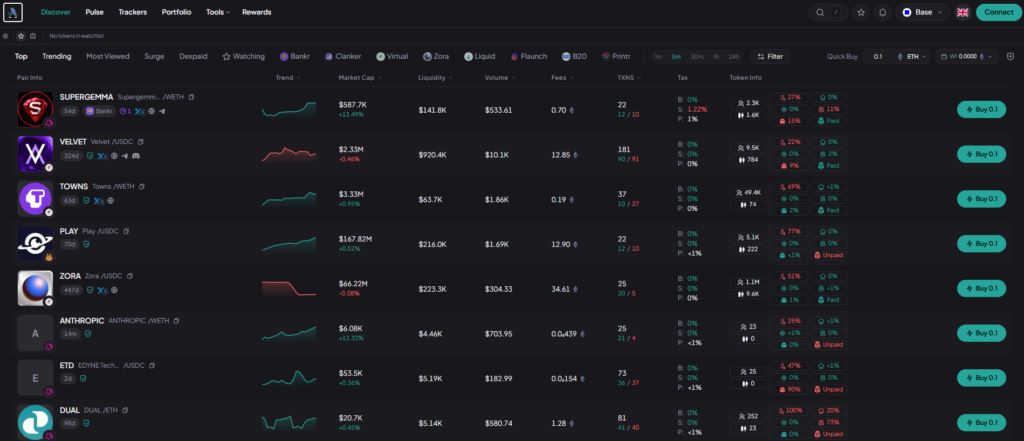
BasedBot is a Telegram-native trading terminal built for traders who want to execute across multiple chains without ever leaving the chat window. It runs entirely through commands and inline buttons inside Telegram, letting you paste a token contract address, review a token safety report, and execute a buy or sell in a few taps — no separate browser tab, no wallet-switching. BasedBot supports a wide roster of EVM chains plus Solana, and Robinhood Chain has been added to that lineup, giving users the same paste-and-trade workflow they’re used to on Base or Ethereum, now pointed at Robinhood Chain’s DEXes.
On the feature side, BasedBot’s core toolkit includes instant token buys and sells via contract address, configurable slippage and gas settings, and an automatic wallet generator (or the option to import an existing wallet via private key or seed phrase) so you’re trading within minutes of opening the bot. Its more advanced tools include anti-rug and dev-sell alerts that flag suspicious contract behavior before you commit funds, copy trading that lets you mirror wallets you trust, and built-in analytics so you can review your win rate and P&L without pulling data manually from a block explorer. BasedBot also layers in stop-loss and take-profit automation, meaning you can set exit conditions once and let positions manage themselves while you’re away from your screen.
Where BasedBot has an edge over a “regular” trading bot is in its combination of speed and reward structure. Because it’s fully Telegram-based, there’s no app to download and no separate login — you’re trading within the same interface you already use to talk to your crypto communities, which shortens the time between spotting a token and getting filled. Its cashback program returns 5–25% of your own trading fees automatically based on volume, with no staking required, and its referral program pays out 30% of fees generated by anyone you refer — traders who stack both often cut their effective fee load by more than half. For a brand-new chain like Robinhood Chain, where early liquidity windows can be short, that speed-plus-fee-efficiency combination is a real advantage over slower, browser-based terminals.
Step-by-step: launching, depositing, and trading on BasedBot
- Open Telegram and search for the official bot, @BasedBotApp (always verify the handle against the link on basedbot.app or the official @BasedTradingBot X account before entering any commands).
- Tap Start — BasedBot will automatically generate a new, non-custodial wallet for you. If you’d rather use an existing wallet, select the import option and enter your private key or seed phrase.
- Copy the wallet address BasedBot gives you, then deposit funds by sending crypto from an exchange or another wallet to that address. For Robinhood Chain, you’ll want to bridge or send the native gas asset plus whatever token you intend to trade with.
- Once your deposit confirms on-chain (usually a few seconds to a couple of minutes depending on network congestion), select Robinhood Chain from the bot’s chain menu.
- Paste the contract address of the token you want to trade. BasedBot will pull up a token report — liquidity, holder distribution, contract risk flags — before you buy.
- Set your buy amount and slippage tolerance, then confirm the trade with one tap.
- Turn on anti-rug alerts and set a stop-loss/take-profit if you plan to hold the position, then monitor performance through BasedBot’s built-in analytics panel.
Maestro
Maestro is one of the original and most established Telegram trading bots in DeFi, live since 2022 and now covering roughly 14 blockchains from a single interface — and Robinhood Chain mainnet went live on Maestro on day one of the chain’s launch. Like BasedBot, Maestro runs entirely inside Telegram, but it distinguishes itself with a much deeper feature set built up over several years, aimed at traders who want granular control rather than just a fast buy button. On Robinhood Chain specifically, Maestro currently supports Uniswap v2/v3, with Uniswap v4 and additional Robinhood-native DEXes like Noxa and DYORSWAP added shortly after launch — meaning coverage of the chain’s liquidity is broad and growing quickly.
read more about Maestro here (a complete, beginner friendly guide)
Maestro’s core features include multi-wallet management (up to 10 general wallets, 5 dedicated copytrade wallets, and 5 autosnipe wallets on the free tier), Auto-Snipe for catching new token launches the moment liquidity appears, and a “Scraper” tool that lets you track and auto-buy from any Telegram group, call channel, or bot. Its more advanced capabilities include patented Anti-Rug and Anti-MEV protection routed through private nodes to prevent sandwich attacks, Entry Price limit orders that automate profit-taking at a percentage gain relative to your buy price, and consolidated position tracking that merges multiple buys of the same token into one unified monitor across all your wallets. A Premium subscription (around $200/month) unlocks 30 concurrent trades, 96-hour trade monitors, 10 copytrade wallets, and priority execution speed for high-volume traders.
Maestro’s edge over a standard trading bot comes down to maturity and breadth. Because it already supports 14 chains with a consistent interface, traders moving to Robinhood Chain don’t have to learn a new tool — they just enable the chain in Maestro’s settings and keep using the same commands, wallets, and safety features they already trust. Its cashback program returns up to 30% of trading fees, among the more generous in the space, and its Anti-Rug/Anti-MEV combination has years of refinement behind it compared to newer bots still building out their protection layers. For traders who want one terminal to handle Robinhood Chain today and whatever chain launches next month, Maestro’s breadth is the main draw.
Step-by-step: launching, depositing, and trading on Maestro
- Open Telegram and search for the official bot (verify against maestrobots.com or the @MaestroBots X account before proceeding).
- Type /start, then join the required Maestro update channels the bot prompts you to join.
- Type /sniper to bring up the main menu, then go to Wallets and either generate a new wallet or import one — Maestro will give you an AES-encrypted private key and seed phrase to store securely offline.
- Under Chain Settings, enable Robinhood Chain (disable chains you don’t plan to use to keep the interface clean).
- Send the native Robinhood Chain gas token to the wallet address Maestro generated, to cover network fees and trading.
- Paste a token contract address into the chat to pull up its Token Report, including liquidity, contract scan, and risk flags.
- Set your buy size, toggle Anti-Rug and Anti-MEV on, adjust slippage/gas under Buy Settings if needed, then confirm.
- Use the Positions Ledger to monitor open trades, and set limit sell orders directly from the Token Report screen for hands-free profit-taking.
Sigma Bot
Sigma is a multi-chain trading bot built around a simple pitch: paste any contract address, and Sigma automatically detects which chain it’s on and switches you there instantly — no manual chain selection required. It runs via Telegram and a companion web terminal, and it added Robinhood Chain support quickly after mainnet launch, giving users access to the chain’s DEXes including Uniswap v2/v3, Noxa, and DYORSWAP directly through Sigma’s existing interface. Sigma has built its reputation specifically around execution speed and gas efficiency, positioning itself as the terminal for traders who care about basis points as much as they care about catching the token itself.
Sigma’s headline features include automatic chain detection from a pasted contract address, bundled approvals and sells on EVM chains (which removes the delay of waiting for a separate approval transaction before you can exit a position), and MEV/reorg protection built into its execution routing. On the advanced side, Sigma offers custom PnL card generation for sharing trade results, a coin-flip cashback multiplier that can double or triple your fee rebates, and a referral and rewards points system layered on top of standard fee discounts. Sigma has also published third-party gas benchmarking showing meaningfully lower gas consumption per trade compared to competing bots — a claim that matters more than it sounds, since on a high-throughput chain like Robinhood Chain, gas inefficiency compounds fast across dozens of trades.
Sigma’s real edge over a generic trading bot is precision at the execution layer. Where many bots focus on flashy features, Sigma’s engineering is concentrated on shaving milliseconds and gas costs off every single transaction — which matters most on a new chain like Robinhood Chain, where liquidity can be thin and slippage punishing in the first weeks after launch. The automatic chain-switching also removes a small but real point of friction: on a chain most traders haven’t used before, not having to think about which network you’re on reduces costly misclicks.
Step-by-step: launching, depositing, and trading on Sigma Bot
- Search Telegram for the official Sigma bot, verified against the @SigmaTrading X account, and tap Start.
- Generate a new wallet through the bot or import an existing one via private key.
- Deposit the Robinhood Chain native gas token to your Sigma wallet address to fund gas and trades.
- Paste the contract address of the token you want — Sigma will auto-detect Robinhood Chain and load the token’s liquidity and safety data without you needing to select the network manually.
- Enter your buy size, confirm slippage settings, and execute; MEV protection is applied automatically on supported routes.
- To exit, use the bundled approval/sell function for a faster, single-step close rather than two separate transactions.
- Check your dashboard for PnL tracking, and opt into the cashback program to start earning fee rebates on future trades.
Fomo

Fomo takes a fundamentally different approach from the other three tools on this list. Rather than a Telegram bot, it’s a standalone mobile and web app built by former dYdX engineers, designed to make onchain trading feel like using a consumer social app rather than a trading terminal. Fomo abstracts away wallets, gas, and bridging entirely: users get a single unified USD-style balance that works across every supported chain, fund their account instantly with Apple Pay or a debit card, and trade with a swipe rather than a multi-step transaction flow. Fomo currently supports Base, Solana, BNB Chain, and Monad, with chain support expanding regularly — and given Robinhood Chain’s rapid growth and its overlap with Fomo’s target audience of retail-friendly, mobile-first traders, it’s a strong candidate for the platform’s next integration.
Fomo’s core features center on its social layer: a real-time feed showing what tokens friends and top traders are buying, public profiles that display a trader’s open and closed positions along with their stated thesis, and the ability to follow accounts to get notified the moment they open a new trade. Its trading features include one-tap buys funded directly by Apple Pay, live cross-chain portfolio and P&L tracking, and a discovery feed that surfaces trending, pre-bonded, and newly graduated tokens without you having to search for them manually. On the advanced side, Fomo is non-custodial — trades settle on-chain through the user’s own keys rather than through Fomo as a counterparty — and the app recently added perpetual futures for non-US users, executed through Hyperliquid’s on-chain order book for sub-second finality.
Fomo’s edge over a traditional bot is accessibility and discovery, not raw execution speed. Where BasedBot, Maestro, and Sigma are built for traders who already know what they want to buy, Fomo is built for traders who want to find their next trade by watching what a trusted network of other traders is doing in real time — a meaningfully different value proposition on a brand-new chain like Robinhood Chain, where the best opportunities are often first spotted by a handful of early movers rather than posted publicly. Onboarding is also dramatically simpler: no seed phrase to write down at signup, no separate wallet app, and funding takes seconds via a card rather than requiring you to already own crypto on another exchange.
Step-by-step: launching, depositing, and trading on Fomo
- Download Fomo from the App Store or Google Play, or visit fomo.family for the web version.
- Create an account in under a minute using your Apple ID or email — no seed phrase required at this step, since Fomo generates and secures your keys for you.
- Tap Deposit and fund your account instantly using Apple Pay or a linked debit card; your balance appears as a single USD-denominated figure usable across all supported chains.
- Browse the home feed for trending tokens, or check the social feed to see what accounts you follow are currently buying.
- Tap a token to view its chart, holder data, and community sentiment, then swipe to buy — Fomo handles the underlying chain routing and gas automatically.
- Track your live P&L and equity curve from the portfolio tab, and set watchlists for tokens you want to monitor without buying yet.
- To exit a position, open it from your portfolio and swipe to sell; funds settle back to your unified balance instantly for withdrawal or reuse.
FAQ
Is Robinhood Chain the same as the Robinhood app I already use for stocks? No. Robinhood Chain is a separate, permissionless Ethereum layer-2 blockchain that Robinhood built and launched on July 1, 2026. It’s connected to the Robinhood ecosystem — Stock Tokens and Robinhood Wallet plug into it — but trading tokens on Robinhood Chain through third-party terminals like the four above happens independently of your regular Robinhood brokerage account.
Do I need a Robinhood account to trade on Robinhood Chain using these bots? No. Because Robinhood Chain is permissionless and Ethereum-compatible, anyone can access it with a standard crypto wallet, the same way you’d access Base or Arbitrum. You don’t need to be a Robinhood brokerage customer to use BasedBot, Maestro, Sigma, or Fomo on this chain.
Which of these four terminals is fastest for sniping new Robinhood Chain launches? Based on current feature sets, Sigma and Maestro are the strongest picks for pure sniping speed, given their MEV protection and execution-focused engineering. BasedBot is competitive and easier to set up for beginners. Fomo isn’t built for sniping at all — it’s designed for social discovery and simple swipe-based trading rather than milliseconds-level execution.
Is trading meme tokens on a brand-new chain risky? Yes. Despite Robinhood Chain’s polish and backing, its early activity has been dominated by speculative memecoins rather than the tokenized real-world assets it was designed for, and new-chain liquidity is typically thin and volatile in the first weeks after launch. Always verify contract addresses carefully, start with small position sizes, use each bot’s built-in anti-rug and contract scanning tools, and never trade more than you can afford to lose.
Do these platforms charge fees? Yes, all four charge a fee per trade (commonly around 1% for the Telegram-based bots), separate from standard network gas costs. Each also offers a cashback or referral program that can meaningfully reduce your effective fee rate — worth setting up before you start trading actively.
This article is for educational purposes only and does not constitute financial advice. Crypto assets, including tokens on newly launched chains, are highly volatile. Always do your own research (DYOR) before trading.