Axiom Review 2026: The Fastest Solana Terminal
Solana memecoin trading punishes slow tools: by the time a clunky interface loads a chart, the entry is gone. Axiom (also known as Axiom Trade, at axiom.trade) was built to fix that, packing token discovery, one-click execution, wallet tracking and Hyperliquid perpetuals into one browser terminal. What sets it apart is both its depth and its baggage: a 2026 insider-access scandal and a reputation for powerful multi-wallet tools. This review is for active Solana traders who want the full picture, speed and risks together, before putting money in.
Sign up for Axiom with code archi1234 for reduced fees
What Is Axiom?
Axiom is a browser-based, non-custodial trading terminal focused on Solana memecoins. It was co-founded in 2024 by Henry Zhang and Preston Ellis and joined Y Combinator’s Winter 2025 batch. According to Solana Compass, it reached $100 million in cumulative protocol revenue in roughly five months, which was described as the fastest milestone in Y Combinator’s history. By mid-2026 it held about 44.6% of daily Solana terminal volume, roughly $51.5 million a day.
The terminal pulls liquidity from Pump.fun, Raydium and Moonshot, and adds tools around it: a launch feed, wallet and X (Twitter) tracking, limit and DCA orders, MEV protection, liquid staking, a fiat on-ramp, and leveraged perps through Hyperliquid.
Quick Facts
| Axiom | |
|---|---|
| Also called | Axiom Trade, axiom.trade |
| Type | Web trading terminal |
| Chains | Solana (primary), limited EVM support, Hyperliquid perps |
| Base fee | 1% per trade, falling to 0.75% net at the top cashback tier |
| Custody | Non-custodial (embedded wallet via Turnkey, or connect your own) |
| KYC | Not required for basic use |
| Backed by | Y Combinator (W25) |
| Best for | Active Solana traders who value speed and tool depth |
Sources for the figures above are Solana Compass and Axiom’s own documentation; always confirm current fees in the app before trading.
Key Features
Pulse: The Token Discovery Feed
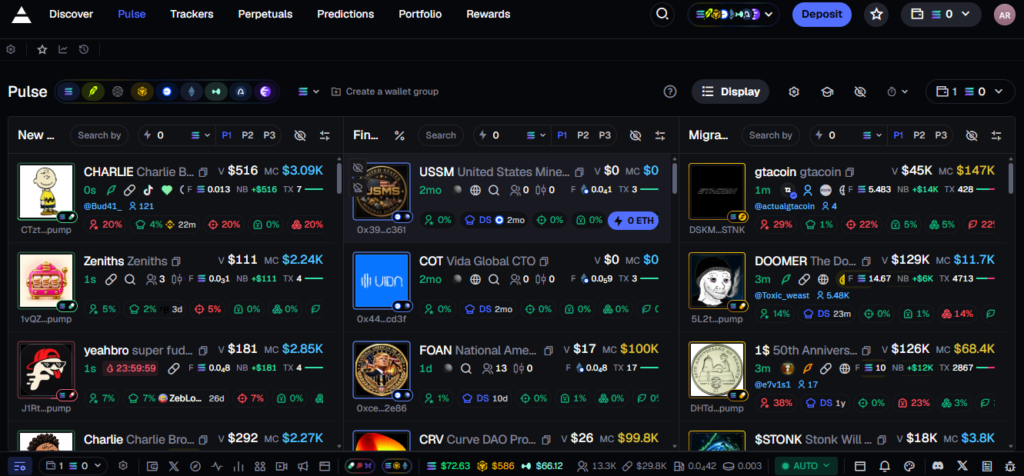
Pulse is the screen most traders live in. It splits new tokens into three tabs: New Pairs (freshly created), Final Stretch (nearing the end of the Pump.fun bonding curve and about to migrate) and Migrated (recently listed on Raydium, newest first). About fifteen filters let you screen by age, market cap, volume, liquidity and holder count, and, importantly, by risk signals such as developer holdings, sniper percentage, insider percentage, top-10 holder concentration and bundle percentage.
A Quick Buy button lets you enter directly from the feed without opening a token page. The risk filters are the part worth learning properly. They show you how much of a token’s supply sits in coordinated hands before you buy, which matters a lot given the controversy later in this review.
Execution Speed and MEV Protection
Axiom routes orders through Jito bundles and advertises trade confirmations under about 400 milliseconds, a claim reported by Solana Compass that you should treat as the company’s own. You get market and limit orders, DCA and TWAP, and “migration actions,” which are preset buy or sell instructions that fire automatically when a token migrates from its bonding curve to Raydium.
Slippage, priority fee and bribe settings are saved as presets, so you can switch between a cautious profile and an aggressive sniping profile in one click. MEV protection has three modes: Off, Reduced (via Jito) and Secure. Most people start on Reduced or Secure and adjust later.
Wallet Tracking, Tweet Monitor and Trader Scan
You can follow specific wallets and see their buys in real time. A Tweet Monitor surfaces token contract addresses when accounts you follow post on X, and Trader Scan profiles a wallet’s trading history before you decide whether it’s worth copying. TradingView charts are embedded, so analysis and execution share one screen.
This is where Axiom feels less like a swap box and more like a trading desk. The caution: wallet-following is only as good as the wallet. A profitable-looking address may simply be one of many coordinated wallets, so check its history rather than trusting a single hot streak.
Multi-Wallet: The Most Praised and Most Criticised Feature
Axiom lets you create or import several wallets in one account, label and group them, switch quickly and view combined or separate PnL. Legitimate uses are common: a separate wallet for flipping, one for longer holds, and a clean wallet for experiments, which limits damage if one address is compromised or tracked.
The controversy is what else the same tooling allows. Public on-chain analyses and posts have alleged that affiliates and power users fund many wallets, buy the same low-cap token together, then distribute into retail demand, a practice usually called bundling. Axiom does not prevent this, and the multi-wallet tools make it easier than on many alternatives. We are not describing it as a how-to, only as something you must be able to recognise: use Pulse’s bundle and insider filters, and be sceptical of tokens where a few linked wallets hold a big share of supply.
If you only want a clean, single-wallet terminal, you can ignore this section of the app entirely.
Hyperliquid Perpetuals
Inside the same interface you can open perpetual futures on Hyperliquid with up to 50x leverage, using USDC as collateral. Deposits and withdrawals move between Solana and Hyperliquid, and profits can be withdrawn back to Solana without leaving the terminal. It’s convenient for hedging memecoin exposure against SOL, but leverage is where beginners lose money fastest. High leverage turns small moves into liquidations, so treat 50x as a ceiling to avoid, not a setting to use.
Staking, On-Ramp and Rewards
Axiom offers direct SOL staking at 0% validator commission, and liquid staking through axiSOL, which charges 5% on staking earnings and a 0.1% withdrawal fee. A Coinbase on-ramp covers fiat deposits, and you can export your seed phrase. Points accrue from trading volume, Hyperliquid activity, quests, referrals and a weekly SOL rakeback. As of mid-2026 no token has been officially confirmed, so treat points as potential upside, not a promise.
Axiom Fees
Axiom charges a 1% platform fee on the swap amount. A seven-tier cashback system then returns part of it in SOL based on cumulative volume, from Wood (0.95% net) up to Champion (0.75% net), with Bronze, Silver, Gold, Platinum and Diamond in between.
| Fee | Cost |
|---|---|
| Base trading fee | 1% of trade size |
| Net fee, entry tier (Wood) | 0.95% |
| Net fee, top tier (Champion) | 0.75% |
| Referral discount | Around 10% off fees on most public links (check how it stacks in the app) |
| Network, priority fee and bribe | Separate and user-controlled |
| axiSOL staking | 5% of earnings, 0.1% withdrawal |
| Monthly subscription | None |
Worked Example
Suppose you trade $20,000 a month in total volume.
- At the 1% base rate, you pay $200 in platform fees.
- At the entry tier (0.95%), you pay $190.
- At the top tier (0.75%), you pay $150.
- If a 10% referral discount applies to the base fee, $200 becomes roughly $180 before cashback.
The lesson: the gap between entry and top tier is $40 a month at this volume, so tiers matter mostly to high-volume traders. Priority fees and tips on top can easily cost more than the platform fee on fast-moving launches. Our dedicated Axiom fees and cashback tiers guide breaks this down further.
How to Start With Axiom
- Create an account. Go to the official Axiom site through our link and sign up with email, Google or an existing wallet.
- Back up your wallet. Axiom generates a non-custodial wallet via Turnkey. Export and securely store the seed phrase immediately, and import it into Phantom or Solflare if you want outside access.
- Fund with SOL. Deposit from an exchange or use the built-in on-ramp. Start with an amount you can afford to lose.
- Set your presets. Choose slippage, priority fee, bribe and MEV mode. Begin with Reduced or Secure and conservative slippage.
- Learn Pulse. Spend time on the three tabs and the filters, especially the bundle, sniper and insider percentages, before buying anything.
- Make a small test trade. Verify fees and fill quality with a tiny order.
- Optional: add wallets. Create extra wallets under Portfolio only if you have a reason, for example separating flipping from holding.
The process takes a few minutes and requires no KYC for basic use.
Axiom vs Competitors
| Axiom | Terminal (Padre) | Trojan | Fomo | |
|---|---|---|---|---|
| Interface | Web | Web PWA | Telegram + web | Mobile-first app |
| Chains | Solana (+ limited EVM) | SOL, ETH, Base, BNB | Solana primary | [VERIFY] |
| Base fee | 1% (0.75% net at top tier) | ~1% | 0.9 to 1% | [VERIFY] |
| Perps | Yes, Hyperliquid up to 50x | Not a focus | Via Hyperliquid | [VERIFY] |
| Standout | Pulse and tool depth | Mobile PWA, 2FA key encryption | Arena cashback | Mobile and social trading |
| Main concern | 2026 insider-access incident | Smaller market share | Solana-centric | Self-custodial but newer |
Share data matters here. Axiom led with roughly 44.6% of Solana terminal volume against Fomo’s 17.2% in June 2026, but reports later in the summer said Fomo had overtaken it in daily volume. Axiom still ranks among the strongest on features, though its lead is no longer unchallenged. For a head-to-head, see our Axiom vs Terminal comparison.
Who Axiom Is Best and Worst For
Best for:
- Active Solana memecoin traders who want discovery, execution and tracking on one screen
- High-volume traders who benefit from the cashback tiers
- Traders who want Hyperliquid perps alongside spot without switching apps
- Users comfortable reading risk filters before they buy
Worst for:
- Complete beginners, since the interface is dense and the market unforgiving
- Anyone who wants a multi-chain terminal beyond Solana
- Traders uncomfortable with the 2026 insider-access allegations
- People who want a mobile-first, minimal app
Risks and Safety: Read This Section
The February 2026 insider-access incident. On 26 February 2026, on-chain investigator ZachXBT published findings alleging that a senior business development employee used an internal support dashboard, described as a “God mode” tool, to look up private user data since early 2025. The allegations said staff could view wallet addresses, transaction histories and linked account data. ZachXBT noted that proving insider trading from on-chain data alone was difficult without Axiom’s internal logs. Axiom confirmed that some team members misused internal customer support tools to query users’ wallets, said it revoked the access, and promised accountability measures.
What this means: non-custodial design protects your funds, not your privacy. Even if nobody can move your coins, an internal tool that exposes who owns which wallet is a real trust problem. Read it as a compliance gap in a company that grew very fast, not necessarily as theft of user funds, but weigh it yourself. Our security incident explainer covers the timeline and practical protections.
Coordinated trading around you. Bundling, where linked wallets buy a token together then sell into retail, is a documented pattern on Solana, and Axiom’s tools can be used that way. Use the bundle, sniper and insider filters, and avoid tokens with heavily concentrated supply.
Memecoin risk. Most memecoins go to zero. Rug pulls, honeypots and thin liquidity are normal, not exceptions.
Leverage risk. Hyperliquid perps at up to 50x can liquidate you fast. If you use them, keep leverage low.
Wallet hygiene. Back up your seed phrase, use a dedicated trading wallet, never keep more than you need for active trading, and withdraw profits regularly. Only use the official Axiom site, as fake clones and phishing links circulate.
Points are not a token. No token had been confirmed as of mid-2026. Don’t trade extra volume just to farm points.
Pros and Cons
Pros:
- Fast execution with Jito routing and MEV protection modes
- Pulse feed with unusually detailed risk filters
- Wallet tracking, Tweet Monitor and Trader Scan in one screen
- Hyperliquid perps without leaving the terminal
- Fees fall to 0.75% net with volume, plus rakeback and points
- Non-custodial, no KYC for basic use, no subscription
Cons:
- 2026 insider-access incident dented trust
- Multi-wallet tools can enable extractive bundling
- Dense interface, steep for beginners
- Solana-centric, limited EVM
- Market share lead challenged by Fomo
- Points rewards have no confirmed token
Verdict
Axiom is still one of the most complete Solana terminals in 2026. Pulse, the execution presets, wallet tracking and built-in perps are hard to match, and the fee ladder rewards volume. If speed and tool depth are your priority and you trade actively, it deserves a place on your shortlist.
But it isn’t a neutral tool, and it isn’t risk-free. The insider-access incident is a real mark against its internal controls, and the multi-wallet design means you will sometimes be trading against coordinated wallets. Use it with a dedicated wallet, small size, and the risk filters switched on. If those trade-offs bother you, consider Terminal (Padre), which emphasises key security and mobile use, or Trojan.
Try Axiom with code archi1234 for reduced fees
Frequently Asked Questions
Is Axiom the same as Axiom Trade? Yes. Axiom Trade (axiom.trade) is the Solana trading terminal. Use only the official site, since lookalike domains exist.
Is Axiom safe? It’s non-custodial, so Axiom does not hold your funds. The main concerns are the 2026 insider-access incident, standard memecoin risk and phishing clones. Use a dedicated wallet and keep balances small.
What are Axiom’s fees in 2026? 1% base, falling to between 0.95% and 0.75% net across seven cashback tiers by volume, with an extra referral discount of around 10% on most links. Network fees are separate.
Does Axiom allow multiple wallets and bundling? Multi-wallet is a built-in feature with legitimate uses. The same tools can be used for coordinated buying, and Axiom doesn’t block it. Use the bundle filter in Pulse to spot it.
Is Axiom good for beginners? It’s powerful but dense. Beginners often find simpler mobile-first apps less overwhelming, and should start with tiny trades.
Axiom vs Terminal (Padre), which is better? Axiom wins on Solana tool depth and perps. Terminal wins on multi-chain support, mobile experience and key security. See our full comparison.
Related Reading
- Terminal (formerly Padre) Review 2026
- Trojan Terminal Review 2026
- Axiom Fees and Cashback Tiers Explained
- Axiom Security Incident Explained
This article is for informational purposes only and is not financial advice. Crypto trading carries significant risk. Some links are affiliate links, and we may earn a commission at no extra cost to you. Always do your own research.
One Comment